
As armed forces worldwide pivot from outmoded conventional and counterinsurgency paradigms toward multi-domain operations to confront hybrid threats, the traditional tools of transformation planning are proving insufficient.
The graveyard of military transformation is crowded with initiatives that looked perfect on paper but failed upon contact with institutional reality. They tend to pursue a single, linear, and often preferred forecast of the future battlefield that introduced significant risk if the forecast was wrong. They also too often view hardware procurement as the heart of the solution. Such legacy planning models fail to account for the asymmetric speeds of commercial technology, cognitive warfare, and the institutional inertia that inevitably paralyzes reform. As armed forces worldwide pivot from outmoded conventional and counterinsurgency paradigms toward multi-domain operations to confront hybrid threats, the traditional tools of transformation planning are proving insufficient. To successfully guide a national military transformation, strategists must realize that they are not merely upgrading a machine. They are rewiring a complex human ecosystem.
A recent allied special operations command transformation initiative bears this out. The shift from kinetic counterterrorism to global multi-domain interoperability showed how defense planners needed to rethink their whole approach to transforming an organization. More than just needing new capabilities, planners had to completely rethink their understandings of future warfare. Planning for the transformation effort succeeded by synthesizing capabilities-based planning, contemporary change management tools, political science frameworks, and the French prospective school of foresight to devise a feasible, suitable, and acceptable plan. We believe this approach shows promise for other military transformation efforts seeking to bridge the gap between strategic design and institutional execution.
Diagnosing the Symptoms, Isolating the Causes
When an allied special operations command recently sought to integrate advanced targeting cycles and cyber capabilities, it relied on a traditional capabilities-based planning model that focused exclusively on sets of discrete, independent technological solutions. While the transformational effort appeared simple, it was ineffective in practice because it overlooked interoperability among the platforms and ignored the need to train and prepare specialized personnel. This should not be surprising. Historically, overly technocentric approaches to transformation often misjudge the complex nature of contemporary warfare, leaving forces ill-prepared for actual operational demands.
Unfortunately, this simplistic, linear approach is attractive for commanders who need quick solutions. The approach conveys a powerful sense of doing something tangible and constructive without disrupting established hierarchical and administrative routines. Consequently, anytime traditional bureaucracies adopt simple, linear solutions, the results are too often costly and disappointing. In contrast, real organizational adaptation requires addressing deeper cultural shifts. Our approach enables those cultural shifts by addressing four common shortcomings of transformation planning, each corresponding to tools and frameworks we incorporated.
Diagnosing the gaps using capabilities-based planning
In general terms, diagnosing an organization’s problems is a step often skipped or sped through because it can consume a lot of time and energy. Choosing off-the-shelf or emerging solutions may save time, but it bypasses the organization’s real needs. Such an approach would not have helped the transformation effort in question. It needed a full diagnostic on the whole organization to identify all potential capability gaps. Capabilities-based planning remains the gold standard for identifying the gaps between a force’s current state and establishing requirements for capabilities needed for the future operating environment. Using a capabilities-based planning workbook available here in WAR ROOM, we were quickly able to map deficiencies in doctrine, organization, materiel, facilities, and other factors to develop a comprehensive look at the shortcomings that transformation should resolve. The same tool also allowed us to consolidate and prioritize the requirements to address each gap based on anticipated future operations.
Explaining the requirements using Parsons’s causal framework
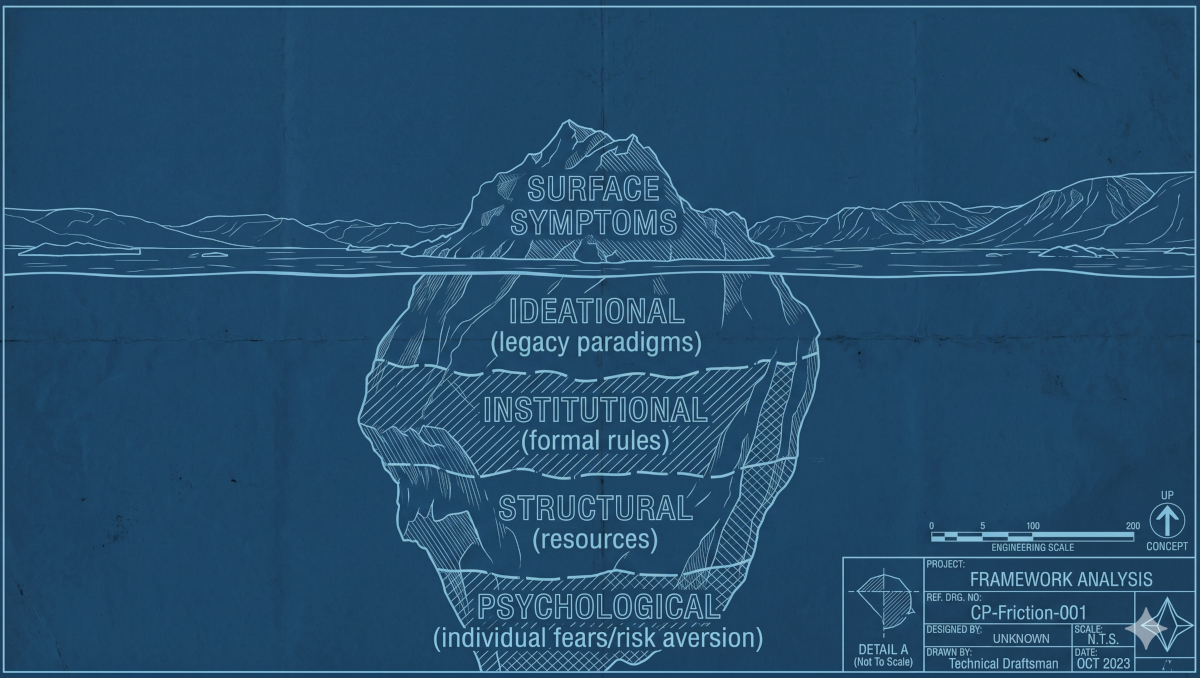
Because military transformation fundamentally disrupts established bureaucratic cultures, it inevitably generates friction. To successfully navigate this, leaders must communicate a compelling case for change that generates institutional buy-in. However, before crafting this strategic message, planners must accurately diagnose the underlying root causes of the organization’s friction, rather than merely treating surface-level symptoms. To bridge this gap between diagnosis and communication, we augmented traditional military planning with analytical frameworks from political science, specifically, Craig Parsons’s methodological approach in How to Map Arguments in Political Science provides a vital analytical filter. This framework forces planners to categorize organizational friction into four distinct causal roots: (1) ideational, represented by the entrenched cultural beliefs and legacy paradigms; (2) institutional, as the formal rules, policies, and reward systems; (3) structural, in the form of physical, technological, and resource configurations; and (4) psychological, within individual human motivations, risk aversion, and fears.
The value of Parsons’s framework is shown in this example from our work. Members of the joint staff continued to prioritize legacy operations despite the commander’s explicit intent to transform. The question was why. It became apparent that the concern was not some structural budgetary constraint but rather an ideational attachment to the glory of past kinetic victories. Upon realizing the source of the resistance, the solution was straightforward. The command needed to re-educate its leaders and confront deep-seated psychological biases within the ranks.
Combatting perverse incentives using institutional economics
Planners also need to map the incentive structures that sustain the organization’s dysfunctional current state. To understand why military staffs behave the way they do, we turned to the field of institutional economics, specifically the Institutional Analysis and Development framework pioneered by Clark Gibson et al. in The Samaritan’s Dilemma. Their framework reminds us that a headquarters is an arena for action governed by rules-in-use. Applying this lens reveals critical obstacles that routinely sabotage transformation efforts.
The first obstacle is usually structural in nature. Strategists must ask whether a joint command has actual binding authority over its service components or is it merely a command and communication hub overseeing very independent and autonomous entities. If the joint command’s authority is weak, transformation efforts quickly fragment into service-specific silos, with army, navy, air force, and other services and agencies protecting their own budgets and resisting joint integration.
If a military claims to want multi-domain specialists, but its promotion boards, medals, and career plans exclusively reward kinetic combat success, operators will rationally reject the new technological path.
The second and most critical obstacle is motivation. An institution will ultimately produce what it rewards. If a military claims to want multi-domain specialists, but its promotion boards, medals, and career plans exclusively reward kinetic combat success, operators will rationally reject the new technological path. This creates a severe institutional moral hazard where the formal strategy demands innovation, but the human resources system punishes it.
The third obstacle to modernization is informational, specifically what Gibson et al. called the “informality trap.” Many militaries mistakenly believe they are interoperable because their commanders share strong personal relationships. However, a RAND Corporation research paper warns that relying on these informal, personal networks is a strategic vulnerability that collapses during high-intensity crises. True interoperability requires leadership to reorient goals and assign formal agency to units, ensuring that the ability to coordinate is a permanent institutional feature rather than a temporary byproduct of individual personalities. We found that measuring interoperability can be done efficiently by analyzing four critical characteristics that show to what extent two units or capabilities are interoperable: (a) technological (“Can you hear me?”), such as the innate ability to cross-communicate; (b) procedural (“Are you listening?”), such as assurances that information is processed; (c) legal (“Are you allowed to tell me?”), such as clearing the jurisdictional and authority hurdles that often block real-time sharing; and (d) cultural/linguistic (“Do you understand me?”), such as shared professional language or doctrine to ensure messages are not lost in translation.
Anticipating push-back and resistance using organization studies frameworks
Turning diagnosis into action requires bold leadership and rigorous change management. The central challenge in moving a combat-proven force toward a new paradigm is preserving its pride while altering its trajectory. The natural reaction of a kinetic operator to a multi-domain transformation is to view it as a threat, a suggestion that their hard-won skills are now obsolete.
To succeed, leaders must frame modernization as an evolutionary shield for the operator’s survival rather than a rupture from the past. However, this vision only takes root if it is anchored in the incentive structure. Unless promotion and evaluation systems aggressively reward new behaviors, they trigger what Gilley, Godek, & Gilley term as the organizational immune system leading to systemic behaviors that reject the transformation to protect the organization’s legacy identity. It is therefore insufficient to communicate the benefits of transformation alone; leaders must also share the costs and risks to the organization and its members of not transforming.
Beyond the Spreadsheet: The Reality Test
It is not enough to introduce new tools into the planning process. The resulting transformation plan must be analyzed for feasibility and suitability. The threats confronting contemporary militaries, such as hybrid warfare and transnational criminal organizations, evolve constantly, requiring that any transformation effort must also be adaptable to emerging realities. In this final step, we turned to the foresight methodologies of the French prospective school, drawing on frameworks developed by Michel Godet in The Art of Scenarios. Instead of attempting to guess the future, Godet’s tools allow planners to map the strategic environment and build resilient forces.
The first step is structural analysis utilizing a cross-impact matrix. By analyzing the interplay of dozens of environmental variables, such as the proliferation of artificial intelligence or the size of defense budgets, this tool isolates the system’s true drivers. Specifically, it identifies the variables that have the greatest influence on the system and the least dependence on other factors. Isolating these core drivers prevents planners from wasting effort on highly visible symptoms, ensuring they address root causes rather than settling for superficial band-aid solutions.
The second step is actor analysis. Military transformations do not happen in isolation of all the other activities of the organization. This methodology forces planners to map the objectives, alliances, and conflicts of all stakeholders, regardless of their relevance to the transformation. It quantifies the bureaucratic resistance of internal service branches, the leverage of international allies, and the asymmetric strategies of hybrid adversaries. This permits a comprehensive look at how transformation efforts can influence or be influenced by the broader organizational context.
Godet warns of the importance of mapping these variables and actors properly and systematically. The risk is leaving out a great many possible futures. These analytical engines provide the empirical foundation to build robust axes of uncertainty. By placing the proposed future military organization into four radically divergent, highly plausible futures, the command can conduct rigorous tabletop exercises and enhance its understanding of the conditions needed for successful transformation. Planners might test the force against a scenario of high institutional unity and combat against low-tech adversaries, then immediately test it against a scenario of severe budget restrictions facing highly advanced cognitive-warfare threats. A transformation plan is only valid if the new operational concept can survive the test of the most hostile, divergent scenarios generated by the structural analysis.
A Multidisciplinary Architecture for Leading Change
The modernization of a national military force in the mid-twenty-first century cannot be achieved by operators and logisticians acting alone. The complexity of hybrid, multi-domain threats, in which adversaries leverage global illicit economies and asymmetric commercial technologies, demands an equally sophisticated approach to institutional redesign. When defense planners limit themselves to traditional planning, they build theoretical forces that are inevitably crushed by the gravity of their own bureaucratic and cultural incentive structures.
The successful military strategist must therefore become a multidisciplinary architect. By using capabilities-based planning to identify the operational horizon, political science frameworks to rewrite the institutional rules, change management to guide the force’s human psychology, and prospective tools to test outcomes, leaders can engineer transformations that survive the initial pitch.
Helmuth von Moltke famously observed that “no plan survives contact with the enemy.” However, the failure of a plan can often be forecasted long before the first shot is fired. The future of strategic overmatch belongs to the militaries that realize their greatest vulnerabilities are not a lack of technology, but failures of institutional design. Ultimately, a transformation is not a technical upgrade; it is an architectural one. Only by hardening institutional cultures can transformations survive the friction of reality.
Oscar Garzon is a colonel and a Special Forces Officer in the Colombian Army. He holds a MA in War Studies from King’s College London. He is a distinguished graduate of the AY26 Resident Course at the U.S. Army War College, as an International Fellow, member of the Carlisle Scholars Program, and recipient of the Colonel and Mrs. Thomas F. Bristol Military History award for outstanding research.
Erick Buckner is a lieutenant colonel and a Field Artillery officer in the U.S. Army. He is a graduate of the AY26 Resident Course at the U.S. Army War College and a member of the Carlisle Scholars Program.
Abdulrahman Alotaibi is a colonel and an Aviation Officer in the Saudi Arabian Army. He holds a PhD in Education, an MA in military sciences and Command, and an MSc in Business Administration. He is a graduate of the AY26 Resident Course at the U.S. Army War College, as an International Fellow and a member of the Carlisle Scholars Program.
The views expressed in this article are those of the authors and do not necessarily reflect those of the U.S. Army War College, the U.S. Army, or the Department of War.
Photo Credit: Created by Gemini

It would be very interesting to see this analytical framework applied to the Army’s efforts around Future Combat Systems, from 2000 to the program cancellation. That started with some doctrinal ideas about an organization with substantially increased ability to detect the enemy, communicate information (enemy, friendly), and move quickly. It was also built around strategic deployability, with the specific operational goal of lasting 96 hours before reinforcement. The intent was to evolve doctrine along with materiel, at least in the early days with involvement from the combat developer community. That led to material requirements, and a program that ended up spending $22b without delivering -anything-.
Seems to me the Army took the institutional approach of “let’s pretend that never happened”. I thought there were lessons to be learned, both good and bad, from what the Army tried with FCS. In intent, it seems to me to have been an attempt to design and equip a force structure around some operational concepts. Why did this fail?
From the bigger — the bold face — introduction to our article above:
“As armed forces worldwide pivot from outmoded conventional and counterinsurgency paradigms toward multi-domain operations to confront hybrid threats, the traditional tools of transformation planning are proving insufficient.”
In this regard, should we not first define “hybrid threats,” and “multi-domain operations,” and, thereby, determine if the concept of multi-domain operations, in fact, is a good “fit” for our hybrid threats problems and needs? Here goes such a definition and analysis attempt, in this instance, with stuff coming from NATO:
Hybrid threats:
“NATO Allies face threats and challenges from both state and non-state actors who use hybrid activities to target political institutions, influence public opinion and undermine the security of NATO citizens. Hybrid methods of warfare – such as propaganda, deception, sabotage and other non-military tactics – have long been used to destabilise adversaries. What is new about attacks seen in recent years is their speed, scale and intensity, facilitated by rapid technological change and global interconnectivity. NATO has a strategy for its role in countering hybrid warfare and stands ready to defend the Alliance and all Allies against any threat, whether conventional or hybrid.” (See the 29 January 2026 NATO Topic article “Countering Hybrid Threats.”)
Multi-Domain Operations:
“At its core, Multi-Domain Operations refers to the push for NATO to orchestrate military activities across all operating domains and environments. These actions are synchronized with non-military activities and enable the Alliance to create desired outcomes at the right time and place. This will enable NATO’s Military Instrument of Power to prepare, plan, orchestrate and execute coordinated activities in collaboration with other stakeholders and actors associated with the Alliance. In doing so, this concept will deliver tailored options that build an advantage in shaping, contesting and fighting and presents dilemmas that decisively influence the attitudes and behaviours of adversaries.” (See the 5 October 2023 NATO article “Multi-Domain Operations in NATO – Explained.)
As to these such definitions:
a. Does it not seem that “hybrid warfare” — while allowing for military activities and operations — seems to emphasize non-military activities and operations; this, while “multi-domain operations” — while allowing for non-military activities and operations — seems to emphasize military operations? (This, potentially making “multi-domain operations” a bad, improper and/or inadequate “fit;” this, as to the “hybrid warfare” threat?). Likewise:
b. Does it not appear that — while “hybrid warfare” looks to be designed to achieve its ends LESS in a large-scale combat operations environment — “multi-domain operations” seems to be designed to achieve its ends MORE IN a “large-scale combat operations” environment? (Again, potentially making “multi-domain operations” a bad, improper and/or inadequate “fit;” this, as to the “hybrid warfare” threat?)
Concluding question:
Thus, as relates to the “hybrid warfare” threat — as I have understood it and addressed it above — and as relates to the “transformation” that we require to adequately and properly address same —
a. Does our current, seemingly more-military-centric/more-large-scale combat operations-centric “multi-domain operations” approach,
b. Does this actually “fit”/”work” — to address our opponents’ current — seemingly less military-centric/less large-scale combat operations-centric — “hybrid warfare” approach?
If I were to change — or compliment — the question that I make at my final “a” and “b” subparagraphs above — to the following:
a. Does our current “fight without winning” approach,
b. Does this actually “fit”/”work” — to address our opponents’ “win without fighting” approach?
Then what institutional, etc., changes would we need to make; this, so as to fix the problem presented thereby?
Maybe try getting rid of “Shock and Awe” as a strategic doctrine? It hasn’t worked since you unveiled it in Iraq and the results are always the same. You do realize it’s not sanctioned by Von Clausewitz, no? Do you even know who Carl is?